
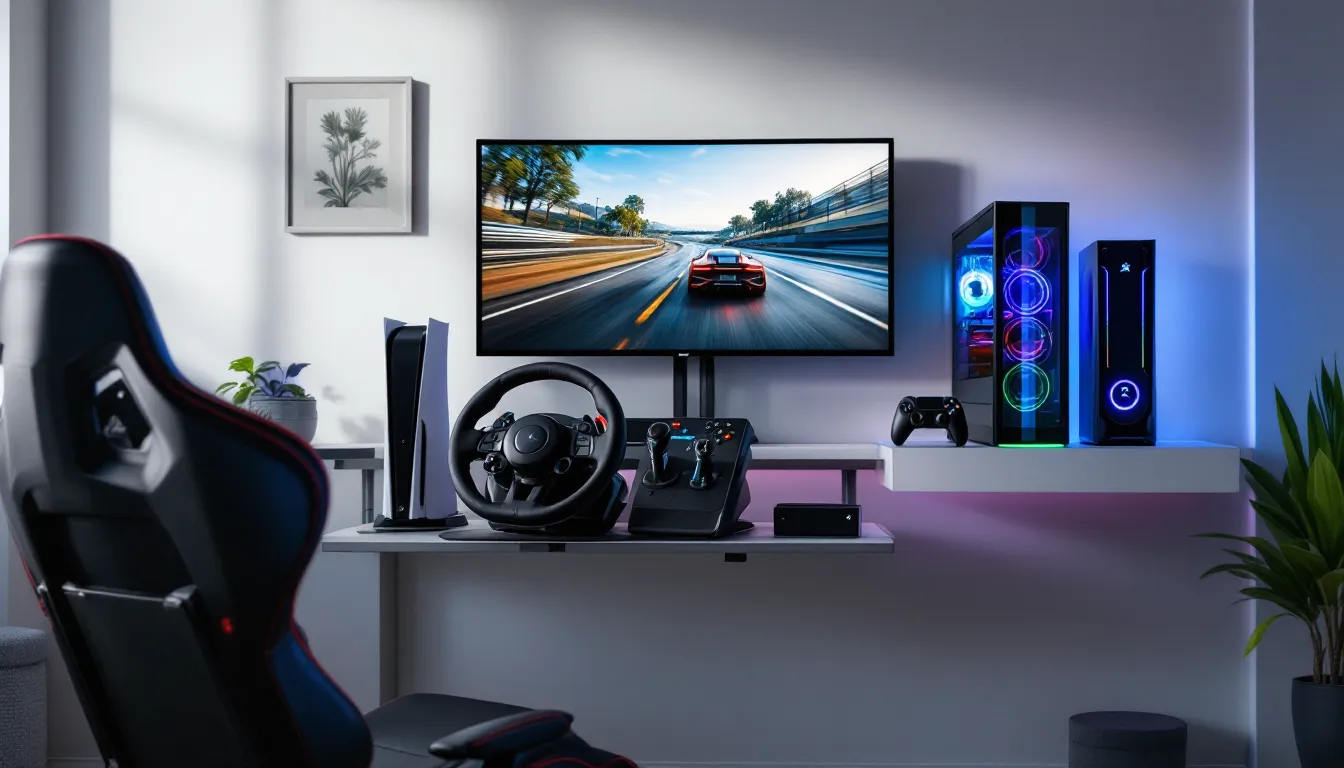

Choosing the right console for racing games isn’t just about picking the shiniest box on the shelf. Whether someone’s drifting through Tokyo streets in a tuned Supra or grinding lap times at Spa-Francorchamps, the platform determines frame rates, load times, exclusive titles, and even how that steering wheel peripheral connects. In 2026, the console landscape offers distinct advantages for different types of racing fans, from simulation purists chasing millisecond precision to casual players who just want chaotic kart racing on a lunch break.
This guide breaks down each platform’s strengths for racing games, covering everything from exclusive titles and hardware specs to wheel compatibility and online ecosystems. By the end, readers will know exactly which console fits their racing style, budget, and setup.
Key Takeaways
- PlayStation 5 is the best console for racing games overall, offering exclusive titles like Gran Turismo 7, superior DualSense haptic feedback, and the healthiest online competitive community for console sim-racing.
- Frame rate consistency, load times, and input lag matter more than peak specifications when choosing a console for racing—most current-gen platforms target stable 60fps, but PS5 and Xbox Series X deliver 3-8 second load times that enable significantly more practice laps.
- PC gaming dominates serious sim-racing through superior peripheral support (direct-drive wheels, load-cell pedals), unlimited frame rates for VR, modding communities, and advanced telemetry tools that consoles cannot match.
- Xbox Series X provides excellent raw performance and Game Pass value for racing fans, but its narrower exclusive lineup and smaller competitive community make it a secondary choice behind PlayStation for console-only players.
- Nintendo Switch excels exclusively for portable arcade racing, with Mario Kart 8 Deluxe remaining the best-selling racing game ever, though it lacks the performance or simulation depth for serious competitive players.
- Racing wheel compatibility remains console-specific due to proprietary security chips, forcing expensive ecosystem-locked purchases—PC offers universal USB compatibility that consoles cannot provide.
Why Your Console Choice Matters for Racing Games
Racing games demand more from hardware than most genres. A shooter can mask 10ms of input lag behind aim assist: a racing sim at 200mph cannot. The console doesn’t just affect visual fidelity, it shapes the entire experience, from how quickly a game loads between retries to whether force feedback feels reactive or mushy.
Different platforms cater to different priorities. Someone building a dedicated sim rig with a direct-drive wheel needs robust peripheral support and high frame rates. A player who values convenience might prioritize instant resume features and quick loading. And for competitive online racers, the size and skill level of the player base matters as much as the hardware specs.
The 2026 racing game landscape also highlights platform-specific advantages that weren’t as pronounced a generation ago. Exclusive titles have become more strategically significant, haptic feedback technology has matured on certain controllers, and subscription services now offer vastly different value propositions for racing fans specifically.
Performance Metrics That Impact Racing Experience
Frame rate consistency matters more than peak frame rate. A locked 60fps beats an unlocked mode that swings between 70-100fps, causing micro-stutters mid-corner. Most current-gen consoles target 60fps for racing games, with performance modes pushing 120fps on supported displays.
Resolution and visual modes typically offer trade-offs:
- Quality mode: 4K/30fps or 4K/60fps with ray-traced reflections
- Performance mode: 1440p-1800p/120fps with reduced effects
- VRR (Variable Refresh Rate) support smooths frame dips on compatible displays
Load times drastically affect the learning curve in sim racing. Shaving 30 seconds off each track restart means 50+ extra practice laps per hour. PS5 and Xbox Series X
|
S SSD architectures deliver 3-8 second loads for most racing titles in 2026, compared to 25-45 seconds on last-gen hardware.
Input lag from controller to screen varies by platform and display mode. Racing wheels generally introduce 3-8ms of additional latency compared to wired controllers. Console-level settings like game mode and performance toggles can reduce this by 10-20ms, which is noticeable when trail-braking into tight corners.
PlayStation 5: The Racing Game Powerhouse
The PS5 has cemented itself as the go-to platform for racing game variety and exclusive content. Sony’s first-party racing portfolio, combined with strong third-party support and innovative controller features, makes it the default recommendation for most racing fans in 2026.
Exclusive Racing Titles on PS5
Gran Turismo 7 remains the flagship, with the April 2026 update (v1.47) adding 12 new cars and a weather rework for Trial Mountain. GT7’s career mode, tuning depth, and VR2 support (running at native 90fps in cockpit view) set the bar for console sim-racing. The online Sport mode maintains a healthy competitive scene with FIA-certified championships.
Other notable PS5 racing exclusives:
- WipEout Pulse Remastered (2025): Anti-gravity racing at 120fps with DualSense adaptive triggers modulating air brake resistance
- MotorStorm: Pacific Rift Remake (2026): Off-road chaos with real-time terrain deformation and haptic feedback for every surface type
Third-party titles also receive PS5-specific features. F1 2026 includes exclusive DualSense integration for tire lock-up feedback, and Assetto Corsa Competizione’s PS5 version runs at a stable 60fps in all weather conditions (compared to frequent drops on Xbox Series S).
DualSense Controller Advantages for Racing
The DualSense controller isn’t just marketing, it genuinely adds immersion for racing games when developers carry out it properly. Adaptive triggers simulate progressive brake resistance and throttle weight, helping players feel the ABS engagement point or turbo lag without a wheel.
Haptic feedback communicates:
- Surface changes (asphalt to gravel to grass)
- Tire slip angle during oversteer
- Gear shift clunks in manual transmission
- Curb rumble with directional precision
In Gran Turismo 7, the DualSense can telegraph understeer through reduced trigger resistance before the car visually responds. This 50-100ms early warning improves lap consistency for controller players significantly.
Not every title uses these features equally. Arcade racers like Wreckfest: Next Gen Edition carry out basic rumble, while sims invest in nuanced feedback programming. The controller technology PlayStation pioneered has influenced cross-platform design standards.
Performance and Graphics Capabilities
The PS5’s hardware delivers:
- Custom RDNA 2 GPU: 10.28 TFLOPS, 36 CUs at 2.23GHz
- CPU: 8-core Zen 2 at 3.5GHz
- 16GB GDDR6 RAM (shared)
- 825GB custom NVMe SSD (5.5GB/s raw throughput)
For racing games, this translates to native 4K at 60fps in quality modes or dynamic 1800p-2160p at 120fps in performance modes. Ray-traced reflections are standard in photo mode but often disabled during gameplay to maintain frame rate targets.
The PS5’s Tempest 3D AudioTech provides positional audio for rival cars in pack racing, helping players judge overtaking gaps without visual confirmation. In VR racing with PSVR2, spatial audio combined with 110° field of view creates the most immersive console racing experience available.
Xbox Series X: The High-Performance Alternative
The Xbox Series X offers raw power and ecosystem advantages that appeal to racing fans who prioritize performance and value. While it lacks the exclusive variety of PlayStation, Microsoft’s racing offerings run exceptionally well and the platform’s broader features support serious racing setups.
Forza Franchise and Racing Exclusives
Forza Motorsport (2023, updated through 2026) has evolved into a legitimate sim-racing competitor since its reboot. The March 2026 update introduced dynamic track evolution that persists across online sessions, meaning the racing line builds grip as more laps accumulate. The tire model now accounts for carcass temperature separately from tread surface temp, affecting handling on cool-down laps.
Forza Horizon 5 continues receiving expansions through 2026, with the Rally Adventure DLC adding proper stage rally events and co-driver pace notes borrowed from professional motorsport. The Mexican map remains the largest open-world racing environment on consoles.
Xbox’s racing exclusive lineup is narrower than PlayStation’s, but what’s there receives long-term support. Turn 10 and Playground Games maintain monthly updates, seasonal content rotations, and active community feedback loops. The lack of a GT7 competitor is the platform’s biggest gap.
Game Pass Value for Racing Fans
Xbox Game Pass Ultimate ($16.99/month as of 2026) includes both Forza titles, plus a rotating selection of racing games. The current catalog contains:
- Dirt Rally 2.0
- F1 2024
- MotoGP 24
- Hot Wheels Unleashed 2
- Need for Speed Unbound
For someone exploring different racing sub-genres, Game Pass delivers $300+ worth of racing games for $200/year. New racing titles often launch day-one into the service, and the EA Play integration (included in Ultimate) adds the Need for Speed and F1 back-catalogs.
The subscription model particularly suits casual racing fans who play a few hours monthly rather than grinding a single sim. Competitive players who focus on one title might find less value, but the breadth of racing content available across platforms has increased subscription appeal.
Hardware Specs and Racing Performance
The Xbox Series X hardware edges out PS5 on paper:
- Custom RDNA 2 GPU: 12 TFLOPS, 52 CUs at 1.825GHz
- CPU: 8-core Zen 2 at 3.8GHz (3.6GHz with SMT)
- 16GB GDDR6 RAM (10GB at 560GB/s, 6GB at 336GB/s)
- 1TB custom NVMe SSD (2.4GB/s raw, 4.8GB/s compressed)
In practice, these advantages manifest as slightly higher resolution targets or more consistent frame rates in demanding scenarios. Forza Motorsport runs at native 4K/60fps with ray-traced reflections on track (not just replays), which no PS5 racing game currently matches during gameplay.
Quick Resume is underrated for racing fans. Switching between Forza Horizon 5, Forza Motorsport, and F1 2026 without closing any of them means instantly jumping back into a suspended race or free roam session. For someone who rotates between sim practice and arcade chill sessions, it’s a genuine quality-of-life feature.
PC Gaming: The Customizable Racing Sim Experience
PC remains the ultimate platform for serious sim-racing, offering peripheral flexibility, visual fidelity, and title selection that consoles can’t match. The trade-off is cost, complexity, and the need to actually understand hardware, but for dedicated racing enthusiasts, those aren’t trade-offs at all.
Sim Racing Advantages on PC
Simulation depth on PC exceeds consoles by a significant margin. Titles like iRacing, Automobilista 2, and rFactor 2 offer laser-scanned tracks, advanced tire physics, and competitive online structures that define modern sim-racing. iRacing’s subscription model ($110/year) and content purchases ($12-15 per car/track) add up quickly, but the competition level and realism justify costs for serious racers.
Frame rate flexibility matters enormously when running triple monitors or VR. A high-end PC (RTX 4080 or better) can maintain 90fps minimum in VR with full grids and weather effects, while even the PS5 with PSVR2 makes visual compromises to hit targets. For flat-screen racing, 1440p ultrawide at 144Hz+ provides wider FOV and smoother motion than any console output.
Modding communities extend game lifespans indefinitely. Assetto Corsa (2014) remains one of the most-played racing sims in 2026 purely due to mods. Players access thousands of community-created cars and tracks, from historic F1 circuits to mountain touge roads. Console versions of AC receive none of this content.
Telemetry and analysis tools integrate directly with PC sims. Software like MoTeC displays real-time data overlays, records sector times with precision timing, and allows post-session analysis of throttle/brake inputs, tire temps, and suspension travel. Professional esports teams use these tools for driver development, and they’re freely available to anyone on PC.
Peripheral Compatibility and Wheel Support
PC supports virtually any racing wheel, pedal set, shifter, and button box through USB or proprietary drivers. This matters when building a serious rig:
Direct-drive wheels from Fanatec, Moza, Simagic, and Simucube range from $500-$3000 and deliver force feedback detail impossible on console-compatible gear-driven wheels. The torque headroom (12-20Nm) allows precise force communication at smaller angles, improving consistency in high-speed corners.
Load-cell brake pedals measure pressure rather than travel distance, mimicking real brake feel. A $300 pedal set with an 80kg load cell provides more lap time improvement than upgrading from a $300 wheel to a $600 wheel. PC supports these through USB, while console compatibility requires specific ecosystem licenses.
Button boxes and stream decks can be mapped to in-game functions like brake bias adjustment, traction control levels, or pit-call menus without taking hands off the wheel. Console button mapping is limited to controller inputs, leaving many advanced sim features buried in pause menus.
Nintendo Switch: Casual Racing on the Go
The Switch occupies a completely different niche in racing games, one that prioritizes fun and accessibility over realism and performance. For arcade racing and portable play, it’s unmatched. For sim-racing or competitive online play, it’s basically irrelevant.
Mario Kart and Arcade Racing Titles
Mario Kart 8 Deluxe (2017) remains the best-selling racing game of all time, sitting at over 70 million copies sold by early 2026. The Booster Course Pass concluded in 2024, bringing the track count to 96, enough content to avoid repetition for hundreds of hours. The gameplay loop is perfect: easy to pick up, impossible to master, with item RNG keeping every race chaotic.
Other standout Switch racing games:
- Crash Team Racing Nitro-Fueled (portable version runs at 30fps but maintains the handling feel)
- Hot Wheels Unleashed 2: 60fps in docked mode, excellent track builder
- Trials Rising: Physics-based motorcycle platforming with precise controls
The Switch library skews heavily toward kart racers and arcade experiences. Attempts at serious racing sims (GRID Autosport, V-Rally 4) run at 30fps with visual compromises that hurt immersion. The hardware simply wasn’t designed for that genre.
Portability vs. Performance Trade-offs
Handheld mode fundamentally changes how racing games feel. The smaller screen reduces situational awareness in pack racing, and the built-in Joy-Con analog sticks lack precision for clean racing lines. But being able to knock out a few Mario Kart cups during a commute or grind time trials in bed has its appeal.
Performance targets on Switch:
- Mario Kart 8 Deluxe: 1080p/60fps docked, 720p/60fps handheld
- Hot Wheels Unleashed 2: 1080p/60fps docked, 720p/30fps handheld
- Grid Autosport: 1080p/30fps docked, 720p/30fps handheld
The frame rate drops in handheld mode are noticeable but not game-breaking for casual titles. Competitive players stick to docked mode with a Pro Controller for the full 60fps experience.
Online play on Switch is less populated and less skill-stratified than other platforms. Mario Kart 8 Deluxe maintains healthy lobbies, but niche titles struggle to fill rooms outside peak hours. The Nintendo Switch Online service ($19.99/year) is cheap, but the peer-to-peer networking often results in laggy races compared to dedicated servers on PlayStation and Xbox.
Racing Wheel and Accessory Compatibility Across Consoles
Wheel compatibility is the most frustrating aspect of console racing in 2026. Unlike PCs where any USB device works with driver support, consoles use proprietary security chips that lock out unlicensed hardware. This creates ecosystem silos that force expensive upgrade decisions when switching platforms.
Which Console Supports Your Racing Setup?
PlayStation 5 requires wheels with a Sony security chip. Most major brands (Logitech, Thrustmaster, Fanatec) offer PS5-licensed models, but they cost $50-150 more than equivalent PC-only hardware. Older PS4 wheels work on PS5 for PS4 games but not for native PS5 titles, a confusing limitation that caught many GT7 players off guard at launch.
Popular PS5-compatible wheels (2026 pricing):
- Logitech G29: $299 (belt-driven, 2.3Nm torque)
- Thrustmaster T300 RS GT: $449 (belt-driven, 3.9Nm torque)
- Fanatec Gran Turismo DD Pro: $699 (direct-drive, 8Nm torque)
**Xbox Series X
|S** uses a similar licensing system but with better backward compatibility, Xbox One wheels generally work with Series X|
S games. The Fanatec ecosystem thrives on Xbox because their modular wheelbase system allows swapping rims and pedals while keeping the licensed base.
PC accepts anything connected via USB. Older Logitech Driving Force GT wheels from 2009 still work perfectly with modern sims. High-end direct-drive wheelbases ($1000+) often ship without console support because PC users represent the serious sim-racing market.
Cross-platform wheels exist but require compromises. The Thrustmaster T248X includes an Xbox license: add the T248P bundle for PlayStation support (requires buying a different SKU). The Logitech G923 offers Xbox or PlayStation versions with identical hardware but different chips.
Handbrakes, shifters, and button boxes generally require the base wheel to pass through inputs, as consoles don’t recognize standalone USB peripherals for racing games. This limits customization compared to PC, where independent USB devices can be mapped freely.
VR headsets add another layer. PSVR2 works exclusively on PS5 and delivers a closed ecosystem with GT7 as the killer app. PC supports Meta Quest 3, Valve Index, HP Reverb G2, and more, with per-eye resolutions up to 2160×2160 and refresh rates reaching 120-144Hz depending on hardware capability.
Online Multiplayer and Community Considerations
The online ecosystem makes or breaks modern racing games. Even the best handling model feels empty without competitive multiplayer, and the quality of matchmaking determines whether online racing is competitive fun or a first-lap wreckfest.
Player population varies significantly by platform and title. Gran Turismo 7 Sport mode maintains the healthiest console sim-racing community, with matchmaking filling lobbies in under 60 seconds across all skill ratings (D through A+). Forza Motorsport’s player count dipped after launch but stabilized around 40k concurrent on Xbox, with crossplay to PC adding another 15k.
Crossplay support has become expected in 2026:
- F1 2026: Full crossplay between PlayStation, Xbox, and PC
- EA Sports WRC: Crossplay for custom lobbies, platform-specific ranked
- Gran Turismo 7: PlayStation-only (no crossplay)
- Forza Motorsport: Xbox and PC crossplay, no PlayStation
Competitive structures differ by game. iRacing on PC remains the gold standard with skill-based matchmaking, safety ratings, and protest systems. Gran Turismo 7’s FIA-certified Sport mode ranks players through daily races with stewarding and penalty systems. Forza Motorsport’s competitive scene struggles with inconsistent corner-cutting penalties that frustrate serious racers.
Leagues and communities thrive on Discord and third-party websites regardless of platform. Dedicated league racing (scheduled events with rules enforcement) provides cleaner competition than public lobbies. Most active racing communities support PS5 and Xbox Series X
|
S but lean toward PC for maximum flexibility.
Latency and netcode quality impacts how racing feels online. Forza uses a predictive model that sometimes causes cars to teleport during laggy moments. Gran Turismo 7 favors accuracy over smoothness, resulting in stuttery rivals under poor connections but fewer phantom collisions. PC sim-racing titles generally carry out better netcode because the competitive community demands it.
Social features on PlayStation include integrated voice chat, easy clip sharing to social media, and PS Party for cross-game communication. Xbox offers similar through Party Chat and Game Clips, with cloud storage for captures. PC relies on Discord for voice, which offers superior audio quality but requires alt-tabbing or dual monitors to manage.
The Best Console for Different Types of Racing Gamers
The “best” console depends entirely on what type of racing experience someone wants. Here’s the breakdown by player profile.
For Simulation Racing Enthusiasts
PC is the clear winner for anyone serious about sim-racing. The combination of iRacing, Automobilista 2, rFactor 2, and modded Assetto Corsa creates a simulation ecosystem no console matches. Peripheral flexibility means building a proper rig with direct-drive wheel, load-cell pedals, and VR without compatibility headaches.
Minimum recommended spec for sim-racing (2026):
- CPU: AMD Ryzen 5 7600 / Intel i5-13400
- GPU: RTX 4060 Ti / RX 7700 XT
- RAM: 16GB DDR5
- Storage: 1TB NVMe SSD
- Estimated cost: $1000-1200 (tower only)
For console-only players, PlayStation 5 edges out Xbox purely because Gran Turismo 7 offers deeper simulation features than Forza Motorsport. The PSVR2 integration adds immersion that Xbox can’t match without a PC.
For Arcade Racing Fans
Nintendo Switch dominates if portability matters. Mario Kart 8 Deluxe is the best arcade racer on any platform, and the ability to play in handheld mode makes it unbeatable for casual pick-up-and-play sessions.
For couch gaming with friends, PlayStation 5 offers the best variety. Gran Turismo 7’s arcade modes, WipEout Pulse Remastered, MotorStorm, plus third-party titles like Wreckfest and Dirt 5 create a diverse arcade library. The DualSense features add tactile fun that gear-heads and casual players both appreciate.
Xbox Series X works fine for arcade racing via Game Pass, but the exclusive lineup is weaker. Forza Horizon 5 is excellent, but after that, the library thins out quickly compared to PlayStation’s breadth.
For Competitive Online Racers
PlayStation 5 currently hosts the most active and skill-diverse competitive racing scene on consoles. Gran Turismo 7 Sport mode runs daily FIA-certified races with proper stewarding and driver rating systems. The player base is large enough that matchmaking finds similarly skilled opponents quickly.
PC offers the highest skill ceiling and most serious competition through iRacing. The ranked system and protest procedures maintain cleaner racing than any console alternative. For someone aiming to compete in sim-racing esports, PC is non-negotiable.
Xbox Series X struggles in competitive racing. Forza Motorsport’s online population is smaller, and the penalty system hasn’t earned community trust. The platform excels at casual online fun (Forza Horizon 5) but lacks the infrastructure for serious competitive racing that GT7 provides.
Conclusion
The best console for racing games in 2026 depends on priorities, but clear winners emerge for each use case. PlayStation 5 delivers the most complete racing experience for console-only players, combining exclusive depth (Gran Turismo 7, WipEout, MotorStorm), PSVR2 immersion, and the DualSense’s tactile feedback. The online community is healthy, and the game library spans from hardcore sims to arcade chaos.
Xbox Series X offers raw performance and Game Pass value but falls short on exclusive variety. It’s the right choice for Forza fans and players who value ecosystem flexibility over racing-specific depth. The hardware is excellent: the software lineup just doesn’t match PlayStation’s racing focus.
PC remains undefeated for serious sim-racing. The peripheral ecosystem, simulation depth, frame rate capability, and competitive structures eclipse consoles entirely. The higher cost and complexity are worthwhile for anyone treating racing games as more than casual entertainment.
Nintendo Switch serves one purpose brilliantly: portable arcade racing. Mario Kart 8 Deluxe alone justifies the platform for casual racing fans, but anyone seeking realism or competitive depth should look elsewhere.
For most racing enthusiasts in 2026, the answer is PlayStation 5 for consoles, PC for serious sim-racing. That combination covers every racing sub-genre, from arcade party games to competitive online championships to VR immersion, without significant compromises.