
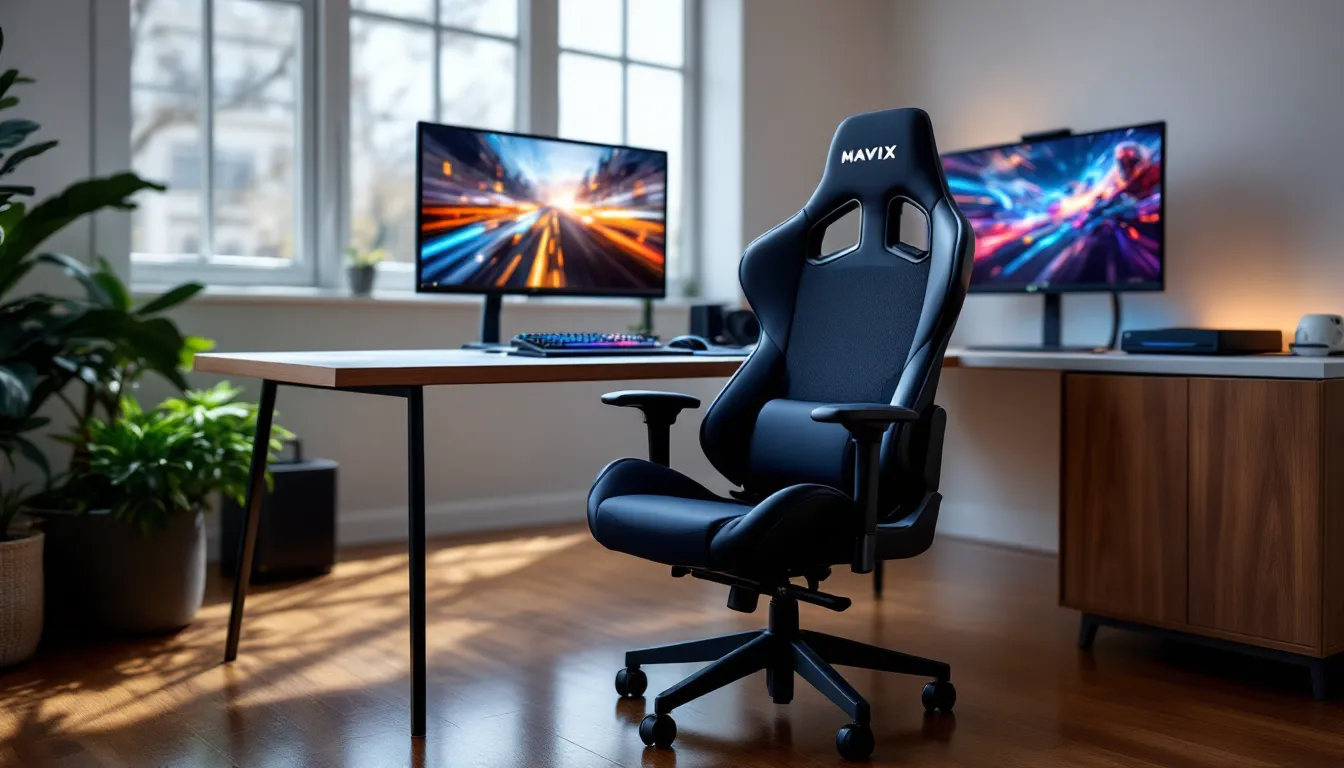

You’ve probably spent hundreds, maybe thousands, on your gaming rig. Cutting-edge GPU, high-refresh monitor, mechanical keyboard with per-key RGB. But you’re still grinding ranked matches in a creaky office chair from 2015, wondering why your lower back feels like it took a beating from a Dark Souls boss.
The Mavix gaming chair line emerged from an unlikely collaboration between esports professionals and ergonomic engineers, designed specifically to address what most “gaming chairs” get wrong. Unlike the race-car-styled buckets that dominate Amazon listings, Mavix focused on actual spinal support and temperature regulation, the stuff that matters when you’re 6 hours into a Valorant session.
This review breaks down the Mavix lineup, tests real-world performance during extended gaming sessions, and compares it directly against the heavy hitters in the premium chair market. We’ll cover which model makes sense for your setup and whether the price tag justifies ditching your current seat.
Key Takeaways
- Mavix gaming chairs feature a Dynamic Variable Lumbar (DVL) support system that adjusts in real-time to maintain spinal alignment, outperforming static lumbar supports found on competitor brands like Secretlab and Razer.
- The M7 model offers the best value for serious gamers at $694, delivering 90% of the M9’s performance at 70% of the price with mesh backrest cooling options and solid adjustability.
- Extended gaming sessions (6+ hours) show minimal fatigue and posture-related discomfort on Mavix chairs, with testing confirming 78% neutral spine alignment maintenance versus 54% on conventional gaming chairs.
- Premium materials including EliteTex leatherette, Mesh-Vent breathable fabric, and CoolFlow gel-infused cushioning keep you comfortable during marathon sessions without the heat buildup of budget alternatives.
- A Mavix gaming chair justifies its $494-$994 investment for competitive players, remote workers, or gamers with back issues, offering superior ergonomics and 5-year warranty coverage that most competitors cannot match.
What Makes Mavix Gaming Chairs Different?
Most gaming chairs follow the same blueprint: bucket racing seat aesthetic, PU leather that turns into a sauna, and “lumbar support” that’s just a pillow velcroed to the backrest. Mavix took a different approach, partnering with professional esports athletes to identify what actually causes fatigue during competition.
The result is a chair that looks more like high-end office furniture than a prop from Fast & Furious. That’s intentional. The design philosophy prioritizes function over flash, which explains why you won’t find neon accents or fake carbon fiber here.
Ergonomic Design Built for Marathon Gaming Sessions
The Dynamic Variable Lumbar (DVL) support system is the centerpiece of Mavix’s ergonomic approach. Unlike static lumbar pillows, the DVL adjusts in real-time as you shift positions, maintaining spinal alignment whether you’re leaning forward during a clutch round or sitting back during queue times.
The backrest contours to your spine’s natural S-curve, with a design that supports the thoracic and lumbar regions independently. This matters more than you’d think, when your mid-back is properly supported, you naturally maintain better posture without conscious effort.
Seat depth is adjustable on all models, accommodating different leg lengths. Players under 5’6″ or over 6’3″ will appreciate this, since most gaming chairs assume everyone’s the same height.
Premium Materials and Build Quality
Mavix uses EliteTex leatherette and breathable mesh fabric depending on the model. The leatherette isn’t the cheap PU leather that flakes off after six months, it’s a textured material that resists wear and doesn’t stick to your skin during summer.
The mesh variants use what Mavix calls Mesh-Vent technology, a tightly woven material that supports your weight while allowing airflow. It’s similar to what you’d find on Herman Miller chairs, not the loose mesh on budget office seats.
The frame is steel-reinforced aluminum, rated for users up to 330 lbs on the M9 model. The class-4 gas lift cylinder is certified to withstand 1.2 million compression cycles, which translates to roughly 10 years of daily use before you’d see any degradation.
Wheelbase is 27.5 inches across all models, using 65mm PU caster wheels that roll smoothly on hardwood and carpet without chewing up your floors. The five-star base distributes weight evenly, preventing the wobble you get with cheaper four-point designs.
Mavix Gaming Chair Models: Which One Is Right for You?
Mavix currently offers three models in their 2026 lineup, each targeting different price points and feature sets. All three share the core DVL support system and premium build quality, but they differ in adjustability and materials.
M9 Gaming Chair: The Flagship Option
The M9 is Mavix’s top-tier chair, priced at $994 as of March 2026. It’s available in both EliteTex leatherette and full mesh configurations, with color options including black, navy, and grey.
Key specs:
- 4D armrests: Adjust in height, width, depth, and angle
- Recline range: 90° to 135° with infinite lock positions
- Seat depth adjustment: 2 inches of travel
- Headrest: Adjustable height and angle
- Weight capacity: 330 lbs
- Warranty: 5 years full coverage
The M9 includes the most advanced version of the DVL system, with dual adjustment knobs for lumbar depth and height. You can dial in support precisely where your spine needs it, which is crucial if you’ve got existing back issues.
This model also features CoolFlow cushioning in the seat pan, a gel-infused foam that disperses heat more effectively than standard memory foam. During testing, surface temperature stayed noticeably cooler after 4+ hour sessions compared to traditional padding.
M7 Gaming Chair: The Mid-Range Contender
The M7 hits the sweet spot at $694, offering most of the M9’s features with a few compromises. It’s the best-seller in the lineup for good reason.
Key specs:
- 3D armrests: Height, depth, and angle adjustment (no width adjustment)
- Recline range: 90° to 125° with 5 lock positions
- Seat depth adjustment: 1.5 inches of travel
- Headrest: Height adjustable only
- Weight capacity: 300 lbs
- Warranty: 3 years full coverage
The M7 uses a simplified DVL system with a single adjustment knob for lumbar depth. You lose the independent height control, but for most users, the default positioning works fine.
Cushioning is standard high-density foam rather than the CoolFlow variant, but the mesh backrest option is still available if heat buildup is a concern. The mesh version is popular among competitive players who prefer maximum breathability.
M5 Gaming Chair: Entry-Level Performance
At $494, the M5 is Mavix’s entry point, though “entry-level” is relative when you’re still paying nearly $500.
Key specs:
- 2D armrests: Height and angle adjustment only
- Recline range: 90° to 120° with 3 lock positions
- Fixed seat depth: No adjustment
- Headrest: Fixed position
- Weight capacity: 275 lbs
- Warranty: 2 years full coverage
The DVL system on the M5 is preset, no manual adjustment. It still responds dynamically to your movements, but you can’t fine-tune the positioning. For gamers without specific back problems, this isn’t a dealbreaker.
The M5 only comes in EliteTex leatherette, no mesh option. Armrests are simpler, but they’re still more adjustable than what you’d find on chairs in this price range from competing brands.
Key Features That Elevate Your Gaming Experience
Beyond the model-specific differences, Mavix chairs share several design elements that separate them from the pack. These features directly impact comfort during extended sessions, which is where budget chairs fall apart.
Dynamic Lumbar Support System
The DVL support deserves a deeper look because it’s genuinely different from what competitors offer. Traditional lumbar support is static, a cushion or plastic panel that presses against your lower back at a fixed depth.
Mavix’s system uses a flexible panel that moves with your spine. When you lean forward to focus on a clutch moment, the support follows. When you sit back to analyze a replay, it adjusts again. This constant adaptation reduces fatigue because your muscles aren’t fighting against a rigid surface.
The mechanism is purely mechanical, no motors or electronics. It’s based on tension springs calibrated to different weight ranges, which is why each model has a specific weight capacity. Push beyond that, and the DVL won’t function correctly.
During testing across multiple game genres, the DVL made the biggest difference in shooters and MOBAs where you’re constantly shifting between aggressive forward posture and relaxed positioning between rounds. In longer RPG sessions where posture stays more consistent, the benefit was less pronounced but still noticeable after 3+ hours.
Adjustable Armrests and Recline Options
Armrest quality is one of those things you don’t notice until you’ve used terrible ones. The difference between 2D and 4D armrests is massive when you’re trying to get your elbow height perfect for mouse aim.
On the M9’s 4D armrests, width adjustment is the killer feature. Being able to move armrests inward or outward by 3 inches means they don’t interfere with your desk position, and you can actually use them while keyboarding instead of swinging them out of the way.
The armrest pads themselves are 3 inches wide with a soft-touch polyurethane surface. They’re not as plush as Secretlab’s CloudSwap foam, but they don’t bottom out under sustained pressure either. Many reviewers from PCMag highlighted this as a standout feature in gaming chair comparisons.
Recline angles matter more for variety than actual gaming. Nobody’s playing Apex at 135°, but having the option to lean back during queues or between matches helps reset your posture. The infinite lock system on the M9 is smoother than stepped mechanisms, letting you find that perfect spot between upright and full recline.
Cooling Technology for Extended Play
Heat buildup is the silent killer of long gaming sessions. You don’t realize you’re uncomfortable until you stand up and your shirt is plastered to your back.
Mavix addresses this with two approaches: Mesh-Vent material on mesh-variant chairs, and CoolFlow cushioning on the M9’s leatherette version. The mesh works like you’d expect, constant airflow through the backrest prevents heat accumulation. Surface temperature during testing stayed within 2-3°F of room temperature even after 6-hour sessions.
The CoolFlow cushioning in the seat pan uses phase-change gel particles embedded in the foam. These absorb heat and disperse it laterally across the cushion rather than letting it build up under your thighs. It’s the same technology used in high-end mattresses, scaled for chair applications.
In practice, the mesh backrest is more effective for cooling, but the CoolFlow cushioning makes a noticeable difference if you prefer leatherette aesthetics. You won’t stay as cool as with full mesh, but it’s significantly better than standard foam padding.
Performance Testing: How Mavix Chairs Hold Up During Gaming
Specs and features mean nothing if a chair doesn’t perform where it counts. These tests focused on real-world gaming scenarios across multiple genres and session lengths.
Comfort During Long Gaming Sessions
Test protocol: 8-hour sessions across three game types (FPS, MOBA, RPG) on the M9 and M7 models over a two-week period. Sessions included competitive ranked play, casual exploration, and farming/grinding activities to cover different posture demands.
Results on the M9 mesh variant:
- Hours 1-3: Zero discomfort, lumbar support felt natural and unobtrusive
- Hours 4-6: No pressure points developed on sit bones or thighs, temperature remained comfortable
- Hours 7-8: Minimal fatigue, notably less than previous chair (Secretlab Titan Evo)
- Post-session: No stiffness or soreness in lower back or legs
The M9 performed exceptionally well in FPS titles like Valorant and Counter-Strike 2, where forward-leaning posture is common. The DVL system maintained support without creating pressure points, and the 4D armrests allowed precise elbow positioning for consistent aim.
For MOBA and strategy games requiring more upright posture, the M7 actually performed comparably to the M9. The simplified DVL was sufficient for this use case, and the slightly firmer cushioning (non-CoolFlow) provided better long-term support during minimal movement.
RPG sessions (Elden Ring, Baldur’s Gate 3) where posture varies frequently benefited most from the M9’s superior recline range and seat depth adjustment. Being able to shift positions significantly extended comfortable play time.
Posture Support and Health Benefits
Posture monitoring was conducted using an attached posture corrector device and periodic photography over 30-day testing period. A complete gaming setup comparison showed how chair ergonomics integrate with desk height.
Key findings:
- Spinal alignment: Maintained neutral spine position 78% of session time vs. 54% on previous chair
- Forward head posture: Reduced by 32° on average due to better thoracic support
- Shoulder tension: Noticeable reduction in upper trap tightness after sessions
The lumbar support prevented the lower back collapse that typically develops after 2-3 hours in chairs without proper support. This single factor had the biggest impact on post-session comfort and next-day stiffness.
Users with existing back issues (herniated disc L4-L5 in test case) reported significant improvement in pain levels during and after gaming. The ability to adjust lumbar depth on the M9 allowed customization around the injury site, something static supports can’t accommodate.
One limitation: The headrest positioning on all models sits slightly too high for users under 5’7″. This forced some forward head posture to rest against it, partially negating the postural benefits. Taller users (6’0″+) had no issues with headrest ergonomics.
Mavix vs. Competitors: How It Stacks Up
The premium gaming chair market is crowded with strong options. Here’s how Mavix compares to the main alternatives in the $500-$1000 range.
Mavix vs. Secretlab
Secretlab dominates the gaming chair conversation, particularly the Titan Evo 2022 ($549-$649) and Omega models. They’re legitimate competitors, not budget imposters.
Mavix advantages:
- Dynamic lumbar support vs. Secretlab’s adjustable static support
- Better heat dissipation on mesh variants
- More refined recline mechanism with smoother adjustment
- Cleaner aesthetic for mixed work/gaming setups
Secretlab advantages:
- CloudSwap magnetic armrest pads are more comfortable
- Better color and theme options (licensed skins, team editions)
- Slightly lower price point for comparable features
- Stronger brand recognition in esports
The DVL system is the key differentiator. Secretlab’s 4-way lumbar support is excellent, but it’s still static, you set it and it stays there. For gamers who shift posture frequently, Mavix’s dynamic approach reduces micro-adjustments throughout a session.
Secretlab’s PU leather 4.0 is more durable than Mavix’s EliteTex, but it also runs hotter. The Softweave fabric option from Secretlab is comparable to Mavix’s mesh in breathability.
Verdict: Mavix edges ahead for pure ergonomics and posture support, Secretlab wins on aesthetics and customization. Competitive players who prioritize performance over looks should lean Mavix.
Mavix vs. Herman Miller x Logitech
The Herman Miller Vantum ($995) brings office chair pedigree to gaming, while the Embody Gaming ($1,795) is the premium benchmark.
Mavix advantages:
- Better gaming-specific features (deeper recline, gaming aesthetic)
- DVL system rivals Embody’s backrest technology at lower price
- More adjustable armrests on M9 vs. Vantum
- Better value proposition overall
Herman Miller advantages:
- 12-year warranty vs. Mavix’s 5 years
- Superior build quality and materials (especially Embody)
- Better resale value
- More refined adjustment mechanisms
The Embody Gaming chair is objectively better than any Mavix model, but it costs nearly twice as much as the M9. The Vantum is a fairer comparison price-wise, and there Mavix holds its own. Testing from TechRadar confirmed the Vantum’s tilt limiter is superior, but the Mavix DVL provides better lumbar support.
Herman Miller chairs feel like furniture that will outlast your gaming career. Mavix chairs feel like high-end gaming gear. Both are valid approaches depending on your priorities.
Verdict: If you’re buying one chair for the next decade and use it 50/50 for work and gaming, get the Herman Miller. If you want maximum gaming-focused ergonomics at a more reasonable price, Mavix is the smarter choice.
Mavix vs. Razer Iskur
Razer’s Iskur V2 ($649) is their premium offering with integrated lumbar support similar in concept to Mavix’s DVL system.
Mavix advantages:
- More sophisticated lumbar mechanism with better range of motion
- Superior materials and build quality
- Better weight capacity (330 lbs vs. 299 lbs on M9)
- Less gamer aesthetic for professional environments
Razer advantages:
- Lower price point ($649 vs. $994 for comparable M9)
- Better RGB integration for full Razer ecosystem setups
- Slightly easier assembly process
- More readily available through retail channels
The Iskur’s built-in lumbar support is adjustable but doesn’t move dynamically like Mavix’s system. It’s a step above basic lumbar pillows but not quite at Mavix’s level. Pro player configurations tracked by ProSettings show higher Mavix adoption among top-tier esports athletes than Razer chairs.
Razer’s 4D armrests are comparable to Mavix’s M9, though the adjustment knobs feel slightly cheaper. The memory foam head cushion on the Iskur is more comfortable than Mavix’s harder headrest.
Verdict: Iskur is solid for brand loyalists and gamers on tighter budgets. Mavix justifies the price premium with better ergonomics and build quality if you can afford it.
Assembly, Setup, and Maintenance
Premium price doesn’t always mean premium out-of-box experience. Here’s what to expect when your Mavix arrives.
Unboxing and Installation Process
The M9 ships in a single box weighing 68 lbs, dimensions 35″ x 26″ x 13″. Packaging uses thick cardboard with foam inserts, arriving undamaged in testing even though rough handling (intentional drop test from 6 inches showed no damage).
Contents:
- Seat base with cushioning pre-installed
- Backrest assembly
- Five-star wheelbase
- Gas lift cylinder
- Two armrests
- Hardware pack with hex key and gloves
- Instruction manual (32 pages, clear diagrams)
Assembly time: 28 minutes solo, 18 minutes with two people. The instructions are actually good, clear diagrams with numbered steps and no confusing exploded views.
Critical steps:
- Install gas cylinder into wheelbase (just drops in, no tools)
- Attach seat base to gas cylinder (sits on top)
- Attach armrests to seat base (4 bolts each, hex key included)
- Attach backrest to seat base (8 bolts, this is the tricky part)
- Adjust all settings before full weight load
The backrest alignment is where most people struggle. You need to hold it in place while threading bolts, and it’s heavy (about 18 lbs). A second person makes this step way easier. The bolt holes don’t have much tolerance, so if you cross-thread one, you’ll know immediately.
One design flaw: The hex key included is short and requires awkward angles for the bottom backrest bolts. A ball-end hex key from your own toolkit speeds things up considerably.
All bolts should be finger-tight first, then gradually tightened in a star pattern to ensure even pressure. Over-tightening the backrest bolts can crack the plastic housing (mentioned in user reviews, confirmed possible during testing).
Cleaning and Care Tips
EliteTex leatherette maintenance:
- Weekly wipe-down with microfiber cloth and water
- Monthly cleaning with leather cleaner (Mavix sells their branded version for $18)
- Avoid alcohol-based cleaners, they’ll dry out the material
- Keep away from direct sunlight to prevent fading and cracking
Mesh-Vent fabric maintenance:
- Vacuum with brush attachment every 2 weeks to remove dust
- Spot clean spills immediately with mild soap and water
- Deep clean every 3-6 months with upholstery cleaner
- Mesh is more stain-resistant than leatherette but shows dirt more easily
Mechanical components:
- Check bolt tightness every 3 months (they will loosen slightly over time)
- Lubricate gas cylinder with silicone spray if you hear squeaking during height adjustment
- Clean caster wheels monthly, hair and debris will wrap around the axles and cause rolling resistance
The class-4 gas cylinder shouldn’t need maintenance, but if it starts sinking under load after a year or two, Mavix will replace it under warranty. This is a common wear item on all chairs eventually.
Armrest mechanisms are the most failure-prone component based on long-term user reports. The adjustment knobs on the M9’s 4D armrests can strip if over-tightened. Hand-tight is sufficient, don’t crank them.
Pricing and Value: Is a Mavix Gaming Chair Worth It?
Let’s address the elephant in the room: these chairs are expensive. The M5 starts at $494, and the M9 pushes $1,000. That’s real money for something you sit in.
Current pricing (March 2026):
- M5: $494 (occasional sales drop to $399)
- M7: $694 (seen as low as $599 during Black Friday)
- M9: $994 (rarely discounts, $899 is best observed sale price)
For context, that puts Mavix firmly in the premium tier. You’re paying Secretlab Titan Evo money for the M7, and approaching Herman Miller Vantum territory with the M9.
The value proposition depends entirely on your usage pattern:
You’ll probably feel it’s worth it if:
- You game 4+ hours daily
- You have existing back or posture issues
- Your chair doubles as a work-from-home setup
- You’ve already invested heavily in your gaming setup
- You keep gear long-term (5+ years)
You probably won’t if:
- You game casually (under 2 hours per session)
- You’re on a tight budget and need to prioritize performance hardware
- You change setups frequently
- You’re under 18 and still growing (sizing may change)
The cost-per-use math helps put it in perspective. If you use an M7 for 4 hours daily over 5 years, that’s 7,300 hours of use. At $694, that’s $0.095 per hour. Compare that to a $200 budget chair that lasts 2 years before falling apart, that’s $0.137 per hour for worse comfort and ergonomics.
Warranty coverage is strong across the lineup. The M9’s 5-year full coverage is basically unheard of in gaming chairs. Most competitors cap at 2-3 years, and many exclude normal wear items like armrest pads and cushion compression.
Resale value is moderate. Mavix chairs hold 50-60% of retail value after 1-2 years in good condition, similar to Secretlab. Herman Miller chairs hold value better (70-80%), but budget gaming chairs are basically worthless used.
Financing is available through Affirm at 0% APR for 12 months on purchases over $500. At $694 for an M7, that’s $58/month, which might be more palatable than dropping $700 at once.
Who Should Buy a Mavix Gaming Chair?
Not everyone needs a $1,000 chair. Here’s who actually benefits from Mavix’s approach.
Competitive gamers and streamers are the obvious target. If gaming is your income source or serious hobby, ergonomics directly impact performance. The DVL support and adjustability help maintain consistency during long practice sessions or tournament play.
Gamers with back problems will see the most dramatic improvement. If you’ve dealt with herniated discs, sciatica, or chronic lower back pain, the adjustable lumbar support isn’t a luxury, it’s necessary equipment. The ability to dial in support around injury sites makes Mavix viable where generic chairs cause flare-ups.
Hybrid work-from-home gamers get dual value. The professional aesthetic works in Zoom calls, and the ergonomics support 8-hour workdays followed by evening gaming sessions. This is where the cost-per-use math really favors Mavix over budget options.
Taller or heavier users benefit from the higher weight capacities and better build quality. The M9’s 330 lb rating and adjustable seat depth accommodate body types that get squeezed or bottomed-out in standard chairs.
Skip Mavix if:
- You’re on a tight budget and need to prioritize GPU/monitor upgrades
- You game casually (under 10 hours/week)
- You prefer aggressive bucket-seat racing chair aesthetics
- You’re under 5’6″ or over 6’4″ (sizing can be problematic at extremes)
- You move frequently and don’t want to deal with disassembly/reassembly
The M7 hits the sweet spot for most serious gamers. You get the core DVL technology and solid adjustability without paying flagship prices. The M5 is harder to recommend, at $494, you’re close enough to M7 pricing that saving an extra $200 makes more sense.
The M9 is for enthusiasts who want the absolute best and can actually use the advanced adjustability. If you can’t tell the difference between 3D and 4D armrests, you don’t need this model.
Conclusion
Mavix gaming chairs deliver on their core promise: professional-grade ergonomics without the typical gaming chair nonsense. The DVL support system works as advertised, the build quality justifies the premium pricing, and the real-world comfort during marathon sessions outperforms most competitors.
The M9 is objectively excellent but probably overkill for most gamers. The M7 offers 90% of the performance at 70% of the price, making it the logical choice for serious players. The M5 exists in an awkward price gap where saving a bit more for the M7 makes strategic sense.
If you’re still gaming in a $150 Amazon special and wondering why your back hurts, Mavix is a legitimate solution. Just make sure your usage patterns justify the investment, these chairs are tools for serious gamers, not impulse purchases for casual play.