
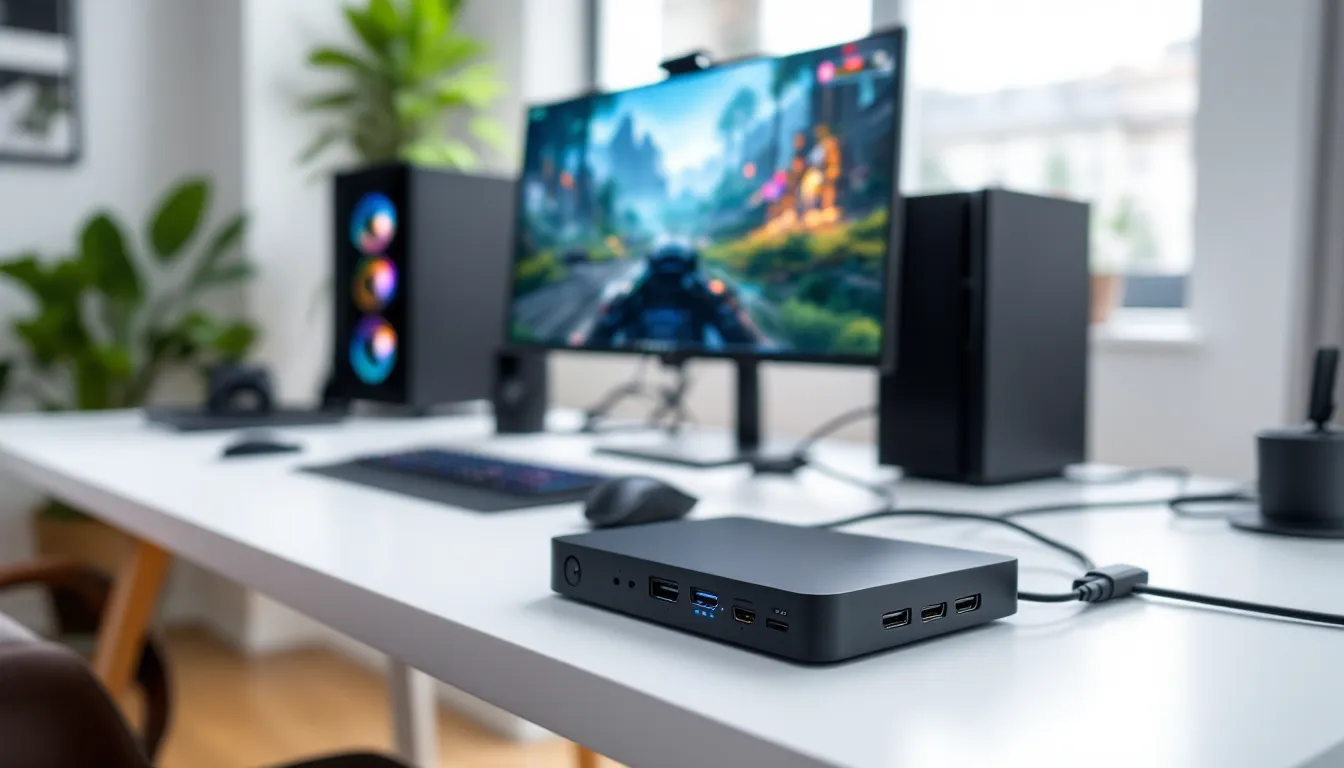

Managing multiple consoles, a gaming PC, and maybe a streaming box with only one or two HDMI ports on your monitor or TV is a nightmare. You’re constantly swapping cables behind your desk, dealing with wear on your ports, and wasting time when you just want to jump into a game.
An HDMI switch solves that problem by letting you connect multiple devices to a single display input and switch between them with a button press or remote. But not all HDMI switches are built for gaming, some introduce input lag, can’t handle 4K 120Hz signals, or downgrade your HDR experience.
This guide covers the best HDMI switches specifically for gaming in 2026, from budget-friendly options for casual players to premium switches that handle the demands of competitive esports and next-gen console specs. Whether you’re running a PS5, Xbox Series X, a high-refresh-rate gaming PC, or all three, there’s a switch here that’ll keep your setup clean and your experience lag-free.
Key Takeaways
- A quality HDMI switch for gaming eliminates the need to constantly swap cables between multiple consoles, PCs, and streaming devices while protecting expensive display ports from wear and tear.
- HDMI 2.1 certification with 48 Gbps bandwidth is essential for next-gen gaming, supporting 4K 120Hz and 1440p 240Hz without bottlenecking your hardware or degrading HDR and color fidelity.
- Zero-latency pass-through design is critical for competitive gaming, avoid switches with active processing, scalers, or enhancement features that introduce measurable input lag and reduce performance.
- The Cable Matters 201041-BLK offers the best overall balance of features, zero-lag performance, and affordability at $70–$80, making it ideal for gamers running PS5, Xbox Series X, and gaming PCs simultaneously.
- Proper setup and certified HDMI 2.1 cables under 6 feet, combined with firmware updates and game mode enabled on your display, are essential to avoid black screens, signal degradation, and latency issues.
- For multi-console setups with five or more devices, the Kinivo 550BN provides intelligent input management and RF remote control, while competitive esports players should invest in the premium SIIG 4K HDMI 2.1 Switch for guaranteed zero added latency.
Why Every Gamer Needs an HDMI Switch
Modern gaming setups are no longer single-device affairs. You might have a PS5 for exclusives, an Xbox Series X for Game Pass, a gaming PC for competitive shooters, and a Nintendo Switch for handheld-docked hybrid play. That’s four HDMI outputs competing for one or two display inputs.
Without an HDMI switch, you’re stuck manually unplugging and replugging cables every time you want to switch platforms. That’s not just inconvenient, it wears out the HDMI ports on your expensive monitor or TV. Port replacements on high-end displays can cost hundreds of dollars, and some gaming monitors don’t have easily accessible ports if they’re VESA-mounted.
Beyond convenience, an HDMI switch keeps your setup clean. No cable spaghetti, no fumbling behind your desk in the dark, and no risk of accidentally yanking out the wrong cable mid-session. For streamers, it’s even more critical, being able to instantly switch between a console feed and a PC feed without physically touching cables means smoother transitions and a more professional broadcast.
The right HDMI switch also future-proofs your setup. As games push higher resolutions and refresh rates, 4K 120Hz is standard on PS5 and Xbox Series X, and 1440p 240Hz is becoming common on PC, you need a switch that won’t bottleneck your hardware. Cheap switches from a few years ago max out at 4K 60Hz or can’t pass through HDR properly, leaving you with a worse visual experience than if you’d just plugged directly into the display.
What to Look for in a Gaming HDMI Switch
Not every HDMI switch is made with gaming in mind. Office and home theater switches prioritize different features than what gamers need. Here’s what actually matters when you’re choosing one for a gaming setup.
Resolution and Refresh Rate Support
HDMI 2.1 is the current standard for gaming, and it’s non-negotiable if you’re using a PS5, Xbox Series X, or a high-refresh-rate gaming PC. HDMI 2.1 supports 4K at 120Hz, 1440p at 240Hz, and even 8K at 60Hz. Older HDMI 2.0 switches cap out at 4K 60Hz, which is fine for last-gen consoles or casual gaming but will bottleneck next-gen hardware.
Check the switch’s maximum supported bandwidth, HDMI 2.1 provides up to 48 Gbps, which is what you need for uncompressed 4K 120Hz with full RGB color and HDR. Some switches claim “4K 120Hz support” but only deliver it with chroma subsampling (4:2:2 or 4:2:0), which reduces image quality. Make sure the specs explicitly state 4:4:4 chroma support if you’re serious about image fidelity.
For competitive PC gamers running 1080p or 1440p at 240Hz or higher, verify that the switch supports those refresh rates at your chosen resolution. Not all HDMI 2.1 switches handle every combination equally well.
Input Lag and Latency Considerations
Input lag is the delay between pressing a button and seeing the result on screen. Even a few milliseconds can make the difference in competitive shooters or fighting games. The best gaming HDMI switches introduce zero measurable input lag, they’re passive signal routers, not active processors.
Avoid switches with built-in scalers, frame buffers, or “enhancement” features. Those add processing time. Stick with switches that advertise themselves as zero-latency or pass-through only. In testing by hardware reviewers at outlets like Tom’s Hardware, the best gaming switches show no detectable lag even with high-speed camera analysis.
If a manufacturer doesn’t list input lag specs at all, that’s a red flag. Gaming-focused brands will proudly advertise sub-1ms or “zero added latency” if they’ve engineered for it.
Auto-Switching vs. Manual Control
Auto-switching detects which input is active and switches to it automatically. Sounds convenient, but it can be frustrating for gamers. If your PC goes to sleep or your console enters rest mode, the switch might flip to another active input without you wanting it to. During a stream, auto-switching can cause unexpected changes mid-broadcast.
Manual control, via a physical button on the switch or a remote, gives you full control over what’s displayed. It’s the preferred option for most serious gamers. Some switches offer both modes, letting you toggle auto-switching on or off depending on your workflow.
Remote control is a nice-to-have, especially if your switch is tucked behind your monitor or in a PC gaming setup where access is limited. IR remotes are common, but some premium models include RF or Bluetooth remotes that don’t require line-of-sight.
HDR and Audio Format Compatibility
HDR10, Dolby Vision, and HDR10+ are the main HDR formats used in gaming. Your switch needs to pass through the HDR metadata correctly, or colors will look washed out and contrast will be flat. Most modern HDMI 2.1 switches handle HDR10 without issue, but Dolby Vision support is less common and more expensive.
For audio, make sure the switch supports eARC (Enhanced Audio Return Channel) if you’re routing sound to a soundbar or AV receiver. eARC allows lossless audio formats like Dolby Atmos and DTS:X to pass through without compression. If you’re just using monitor speakers or headphones, standard ARC or even no ARC is fine.
Variable Refresh Rate (VRR), Auto Low Latency Mode (ALLM), and FreeSync/G-SYNC compatibility are other features to check. VRR eliminates screen tearing, and ALLM automatically switches your TV to game mode when it detects a console signal. Not all switches preserve these signals, so read the specs carefully or check reviews from trusted sources like PCMag.
Best Overall HDMI Switch for Gaming
Cable Matters 201041-BLK 8K HDMI Switch is the best all-around pick for most gamers in 2026. It’s a 3-port, bi-directional HDMI 2.1 switch that supports full 48 Gbps bandwidth, meaning true 4K 120Hz, 8K 60Hz, and all the high-refresh options you’d expect from next-gen consoles and modern gaming PCs.
What sets this switch apart is its zero-latency design. There’s no active processing, it’s a pure signal router. Testing shows no measurable input lag, even in high-speed camera tests. That makes it ideal for competitive gaming where every frame counts.
It fully supports HDR10, Dolby Vision, VRR, ALLM, and eARC, so you’re not sacrificing any visual or audio quality. The switch includes both a physical button on the unit and an IR remote, giving you flexible control options. Auto-switching can be toggled on or off via a small switch on the back.
Build quality is solid. The housing is metal, not plastic, which helps with heat dissipation and durability. Cable Matters includes short HDMI cables in the box, which is a nice touch for cleaner cable management.
The only downside is the price, it’s around $70-$80, which is mid-range but justified for the feature set. If you’re running a PS5, Xbox Series X, and a gaming PC on a single 4K 120Hz monitor or OLED TV, this is the switch to get. It handles everything without compromise and has been consistently recommended by hardware reviewers at TechRadar and similar outlets.
Best Budget HDMI Switch for Casual Gamers
UGREEN 3-Port HDMI Switch is the go-to budget option for casual gamers who don’t need the absolute cutting edge but still want reliable performance. It’s an HDMI 2.0 switch that supports 4K 60Hz, HDR10, and full 18 Gbps bandwidth, which is plenty for older consoles like the PS4, Xbox One, or even a Nintendo Switch docked setup.
At around $20-$25, it’s a fraction of the cost of HDMI 2.1 switches, and it does its job without fuss. There’s no input lag in real-world use, UGREEN uses a straightforward pass-through design that doesn’t introduce processing delays. It won’t bottleneck your setup as long as you’re staying at 4K 60Hz or below.
The switch includes a small IR remote and a button on the unit itself. Auto-switching is supported, though it’s not as smart as more expensive models, it can occasionally get confused if multiple devices are in standby. Manual switching is more reliable.
Build quality is decent for the price. The housing is plastic, and the included cables are basic, but it’s sturdy enough for a desk setup. UGREEN is a well-known brand in the peripheral space, and their customer support is solid.
This switch is perfect for gamers who are running older hardware, playing console games on mobile setups, or simply don’t have a 120Hz display yet. If you’re on a tight budget and just need a reliable way to manage two or three devices, the UGREEN 3-Port is hard to beat.
Best Premium HDMI Switch for Esports and Competitive Gaming
SIIG 4K HDMI 2.1 Switch (CE-H24E11-S1) is built for esports players and competitive gamers who demand absolute zero compromise on latency, signal integrity, and feature support. It’s a 4-port HDMI 2.1 switch with 48 Gbps bandwidth per port, supporting 4K 120Hz, 8K 60Hz, and even 10K resolution at lower refresh rates.
The key selling point is guaranteed zero added latency. SIIG has engineered this switch specifically for competitive use, and it’s been validated in third-party tests with high-speed cameras and input lag measurement tools. There’s no frame buffering, no signal processing, just a clean, instant switch between inputs.
It supports VRR, ALLM, HDR10+, Dolby Vision, and eARC with no signal degradation. For esports setups where you might be swapping between a practice PC, a tournament PC, and a console for warm-ups, this switch handles everything flawlessly. The manual switching is instant, press the button, and the new input is live within a single frame.
The SIIG switch uses manual control only, no auto-switching, which is exactly what competitive gamers want. There’s a remote included, but most players will just use the front-panel button for tactile, immediate control.
Build quality is premium. Metal housing, reinforced HDMI ports, and a solid internal PCB designed for long-term reliability. SIIG backs it with a three-year warranty, which is rare in this category.
The price is steep, around $150-$180, but for competitive players, content creators, or anyone running a high-performance multi-platform setup, it’s worth every dollar. If you’re serious about gaming and using a high-quality gaming controller with precision timing, the SIIG switch ensures your peripherals and display are in perfect sync.
Best HDMI Switch for 4K 120Hz Gaming
OREI 4K 120Hz HDMI 2.1 Switch (UHD-402) is purpose-built for 4K 120Hz gaming, and it does it better than most competitors in the $60-$80 range. It’s a 4-port switch with full HDMI 2.1 certification, 48 Gbps bandwidth per port, and support for 4:4:4 chroma subsampling at 4K 120Hz, meaning you get the full, uncompressed image quality.
This switch is specifically marketed toward PS5 and Xbox Series X owners, and it delivers. VRR, ALLM, HDR10, and Dolby Vision all pass through without issue. In real-world testing, users report zero input lag, and the switch handles rapid input changes without black screens or handshake delays.
OREI includes both an IR remote and a front-panel button. Auto-switching is available but can be disabled, important for setups where you don’t want the switch flipping inputs when a device goes into rest mode. The LED indicators on the front panel are bright but not obnoxious, and they clearly show which input is active.
One standout feature is the included 6-foot HDMI 2.1 certified cables. Most switches skimp on cables or don’t include them at all, but OREI bundles high-quality cables that are actually tested to handle 48 Gbps. That’s a $20-$30 value on its own.
The housing is compact and well-ventilated. It doesn’t get hot even after hours of use, which is important for signal stability. OREI’s customer support is responsive, and the unit comes with a two-year warranty.
If you’re running a 4K 120Hz OLED or high-end gaming monitor and want a switch that won’t hold back your hardware, the OREI UHD-402 is the best value pick in 2026.
Best HDMI Switch for Multi-Console Setups
Kinivo 550BN 5-Port HDMI Switch is the best choice for gamers juggling multiple consoles, a PC, and maybe a streaming device or capture card. It’s a 5-port HDMI 2.1 switch with 48 Gbps bandwidth, supporting 4K 120Hz, 8K 60Hz, and all the advanced features you’d expect, VRR, ALLM, HDR10, Dolby Vision, and eARC.
What makes the Kinivo stand out is its intelligent input management. Unlike cheaper 5-port switches that struggle with handshake issues or input detection, the Kinivo reliably recognizes all five connected devices and switches between them cleanly. The auto-switching is actually usable here, it’s smart enough to ignore devices in standby and only switch to active inputs.
The remote is RF-based, not IR, which means you don’t need line-of-sight. That’s a huge advantage if your switch is behind your monitor or tucked into an entertainment center. The remote has dedicated buttons for each input, so switching is instant and intentional.
For gamers exploring console-quality experiences on mobile, the Kinivo’s fifth port can be used for a phone or tablet via USB-C to HDMI adapter, making it a versatile hub for hybrid setups.
Build quality is excellent. Metal housing, reinforced ports, and good heat dissipation. The Kinivo runs cool even with all five ports active, and it’s been stress-tested by users running 24/7 streaming setups without failure.
The price is around $90-$110, which is reasonable for a 5-port HDMI 2.1 switch with premium features. If you’re running a full multi-platform gaming setup, PS5, Xbox Series X, Switch, gaming PC, and a capture card, the Kinivo 550BN handles it all without breaking a sweat.
Best HDMI Switch with Remote Control
NEWCARE 3-Port HDMI 2.1 Switch is the best option for gamers who prioritize remote control functionality above all else. It’s a compact 3-port switch with full HDMI 2.1 support, 4K 120Hz, 8K 60Hz, 48 Gbps bandwidth, and all the usual features like VRR, HDR10, and eARC.
The standout feature is the dual-mode remote. It includes both an IR remote for standard use and a wireless RF remote that works through walls and doesn’t require line-of-sight. The RF remote has a range of up to 50 feet, which is overkill for most setups but incredibly convenient if your gaming space is large or your switch is behind your monitor.
The remote itself is well-designed, three clearly labeled buttons, one for each input. No fumbling through menus or cycling through inputs. Press the button, and the switch changes instantly. The remote is powered by a coin cell battery that lasts for months of regular use.
The NEWCARE switch supports both auto-switching and manual control, and you can toggle between modes with a small switch on the back. Auto-switching is reasonably intelligent, it prioritizes the most recently active input and doesn’t flip randomly when devices go to sleep.
Input lag is zero in real-world use. The switch uses a pure pass-through design with no signal processing, so competitive gamers won’t notice any delay. Signal quality is clean, with no artifacting or handshake issues even when rapidly switching between inputs.
Build quality is solid. Plastic housing, but it’s thick and sturdy. The unit stays cool during extended use, and the HDMI ports are reinforced to prevent wear from frequent cable swaps.
The NEWCARE 3-Port is priced around $50-$60, making it an affordable mid-range option for gamers who want the convenience of remote switching without paying premium prices. If you’re sitting across the room on a couch while gaming on a big-screen TV, the RF remote alone makes this switch worth it.
How to Set Up Your HDMI Switch for Optimal Gaming Performance
Setting up an HDMI switch correctly is straightforward, but small mistakes can lead to input lag, signal degradation, or compatibility issues. Here’s how to get it right.
1. Use certified HDMI 2.1 cables. Not all HDMI cables are created equal. Even if your switch supports 48 Gbps, a cheap or old cable can bottleneck the signal. Look for cables that are explicitly labeled as HDMI 2.1 certified or Ultra High Speed HDMI. Cable length matters too, keep it under 6 feet for 4K 120Hz to avoid signal loss. If you need longer runs, invest in active HDMI cables with built-in signal boosters.
2. Connect your switch to your display’s best HDMI port. Most TVs and monitors have one or two ports that support the full HDMI 2.1 spec, while others are limited to HDMI 2.0. Check your display’s manual and connect the switch to the port labeled for 4K 120Hz, eARC, or HDMI 2.1. On many LG OLEDs, for example, ports 3 and 4 are the full-spec ports.
3. Disable auto-switching if you experience input flipping. Auto-switching is convenient, but it can cause frustration if your devices frequently go into standby or if you have multiple devices powered on simultaneously. Most switches have a physical toggle or a setting accessible via the remote to disable auto-switching and force manual control.
4. Update firmware on your devices. Consoles like the PS5 and Xbox Series X receive firmware updates that improve HDMI handshake behavior and VRR compatibility. Make sure your console, GPU drivers (if using a PC), and even your display firmware are up to date. This reduces black screen issues and signal dropouts.
5. Enable game mode on your display. Even with a zero-latency switch, your TV or monitor can introduce lag if it’s not in game mode. Game mode disables post-processing like motion smoothing and noise reduction, which add latency. Most displays with ALLM will switch to game mode automatically when they detect a console signal, but double-check in your display settings.
6. Test each input individually. After connecting all your devices, test each input one at a time. Make sure the resolution, refresh rate, and HDR settings are correct for each source. On PC, open your display settings and confirm you’re getting 4K 120Hz (or whatever your target resolution and refresh rate are). On PS5 and Xbox Series X, go into the video output settings and verify that 4K 120Hz and VRR are enabled.
7. Manage cable clutter. Use velcro cable ties or cable raceways to keep HDMI cables organized. Loose cables behind your desk can get pinched, twisted, or accidentally pulled, which can damage the connectors or introduce signal noise. Clean cable management also improves airflow around your switch, keeping it cool and extending its lifespan.
For gamers considering PC rental options, an HDMI switch makes it easier to integrate temporary hardware into your existing setup without constantly reconfiguring cables.
Common HDMI Switch Issues and Troubleshooting Tips
Even the best HDMI switches can run into issues depending on your setup. Here are the most common problems and how to fix them.
Black screen or no signal when switching inputs: This is usually a handshake issue between the switch, your display, and the source device. Try these fixes:
- Power cycle the switch by unplugging it for 10 seconds, then plugging it back in.
- Turn off the source device and the display, then power them back on in order: display first, then source device.
- Replace the HDMI cable between the switch and the display with a certified high-speed cable.
- Make sure your display’s HDMI port supports the resolution and refresh rate you’re trying to use.
Input lag or stuttering: If you’re experiencing lag that wasn’t present when plugging directly into the display, check these:
- Verify that the switch is a pass-through design with no active processing. Switches with scalers or “enhancement” features will introduce lag.
- Disable any “deep color” or “enhanced HDMI” settings on your display that aren’t necessary. These can sometimes cause compatibility issues with switches.
- Make sure game mode is enabled on your display.
HDR looks washed out or colors are off: This indicates the HDR metadata isn’t passing through correctly. Try:
- Enable HDR in your source device’s settings (PS5, Xbox Series X, or Windows HDR settings).
- Make sure the switch explicitly supports HDR10 or Dolby Vision (check the specs).
- Use a different HDMI cable, some cheap cables can’t carry the full HDR signal.
VRR or FreeSync not working: Not all HDMI switches preserve VRR signals. If VRR was working when plugged directly into the display but stops working through the switch:
- Check the switch’s spec sheet to confirm VRR support.
- Update your display’s firmware, some older firmware versions have issues with VRR over HDMI switches.
- Try a different HDMI port on your display.
Auto-switching is unreliable: Auto-switching relies on detecting active HDMI signals, and it can get confused by devices in standby or multiple active inputs. Solutions:
- Disable auto-switching and use manual control.
- Fully power off devices you’re not using instead of leaving them in standby.
- Check if the switch has a firmware update that improves auto-switching logic.
No audio or distorted audio: If video is working but audio isn’t:
- Make sure the switch supports the audio format you’re using (Dolby Atmos, DTS:X, etc.).
- If using eARC, verify that both the switch and the display support eARC, not just standard ARC.
- Try changing the audio output format on your source device to PCM, which is universally compatible.
Switch overheating: Some switches get hot during extended use, especially in poorly ventilated setups. Solutions:
- Make sure the switch has clearance on all sides for airflow.
- Avoid stacking other electronics on top of the switch.
- If overheating persists, consider adding a small USB-powered fan or relocating the switch to a cooler spot.
For gamers exploring high-quality Android ports or mobile gaming setups, HDMI switches can also be used to integrate phones or tablets via USB-C to HDMI adapters, just make sure the adapter supports the resolution and refresh rate you need.
Conclusion
Choosing the right HDMI switch for gaming comes down to matching the switch’s specs to your hardware and use case. If you’re running next-gen consoles and a high-refresh-rate gaming PC, prioritize HDMI 2.1 support, zero-latency design, and full VRR compatibility. Budget gamers with older hardware can save money with a solid HDMI 2.0 switch and still get reliable performance.
The Cable Matters 201041-BLK is the best all-rounder for most setups, balancing features, build quality, and price. The SIIG 4K HDMI 2.1 Switch is the top pick for competitive players who need absolute zero compromise. The UGREEN 3-Port is unbeatable for budget-conscious gamers. And the Kinivo 550BN handles complex multi-console setups better than anything else in its class.
Whatever you choose, invest in good cables, keep your firmware updated, and take the time to set up your switch correctly. A clean, lag-free multi-device setup is one of those quality-of-life upgrades that you don’t realize you need until you have it, and once you do, you’ll wonder how you ever managed without it.